
Wholesale Coffee vs. Retail Coffee: What’s Actually Different?
When people search for wholesale coffee vs. retail coffee, they’re usually trying to figure out one thing: what’s actually different, and is wholesale really worth it? Before making a deep comparison, here is a brief overview of the simple differences:
Wholesale coffee is coffee purchased directly from a roaster or wholesale supplier, usually in larger quantities and on an ongoing basis. It may come in packaging designed for commercial brewing and often includes wholesale pricing, account support, and other services that aren’t normally part of a retail purchase.
Retail coffee is generally packaged and priced for individual consumers buying smaller quantities, often through grocery stores, retail shops, or online retailers.
Some of the areas that are part of our comparison include: pricing, roasting, packaging, ordering, customer service and the actual source of the coffee.
Price is really the result of everything that happens before the coffee gets to you. Where it’s sourced, how it’s roasted, how it’s packaged, and what kind of support you get can all make a difference in the coffee you serve. Those differences are what I would look at when comparing a true wholesale relationship with simply buying coffee in larger quantities.
Here’s what actually separates wholesale and retail:
Difference 1: How is the price determined?
Retail pricing usually has a lot more steps between the roaster and the person buying the coffee. A bag on a grocery shelf has paid for a distributor, a broker, retail shelf space, promotional placement, and a marketing budget. It also has to price in the possibility of sitting unsold for months. All of that gets folded into the sticker price.
Wholesale pricing has fewer steps between the roaster and you. You’re buying from the roaster, in volume, on a recurring basis. There’s no shelf to rent and no distributor taking a cut. With wholesale, you’re generally paying for the coffee and the roaster’s margin without all of those additional retail costs built into the price.
Is wholesale coffee cheaper? Usually, wholesale coffee has a lower per-pound price than comparable retail coffee, but that doesn’t necessarily mean it has the lowest cost per cup. The amount of coffee you use, the quality of the coffee, packaging, shipping, and brewing method can all affect your actual cost.
This is also why wholesale pricing is usually tiered rather than flat. When a customer orders more consistently and in larger quantities, it also costs us less to process those orders, so we can pass some of that savings along. Our HOPE Partner discount works exactly this way — 10% on orders from $1 to $149.99, 15% from $150 to $299.99, and 20% on orders of $300 and above.
For example, if you’re buying coffee for a church that serves several hundred cups every Sunday, the price of the bag is only part of the calculation. You also need to consider how much coffee you’re using per batch, how consistently volunteers measure it, how much gets wasted, and how often someone has to make a trip to buy more coffee.
Difference 2: How fresh is the roast?
One of the biggest things to look at is the roast date of the coffee. How fresh is it? It is not always obvious from the bag.
Retail coffee is built for a long shelf life because it needs one. The coffee has to be roasted, packaged, shipped to a distribution center, shipped to a store, stocked, and then wait for a buyer. That’s often months. Many retail bags use a “best by” date rather than prominently showing the roast date, which tells you when the manufacturer stops vouching for it, not when it was actually roasted.
With a good wholesale roaster, coffee is roasted based on actual customer demand rather than sitting around for months waiting to be sold. It ships from the roastery to you. There are simply fewer steps between the roaster and the customer.
At HOPE Coffee, we roast several times a month specifically to keep this window short. There isn’t one universally agreed-upon number of days that defines coffee as “fresh”.’ Brew method, packaging, storage, and personal taste all matter. What we do know is that we prefer to roast closer to when our customers need the coffee. Regardless of where you fall on the exact definition of freshness, it makes sense that coffee sitting in a warehouse for months isn’t going to be as fresh as coffee roasted closer to when you need it.
Practical test: ask any supplier when your specific order was roasted. A good wholesale roaster should be able to tell you. If a supplier can’t tell you when the coffee was roasted, that’s something I’d want to ask more questions about. At HOPE Coffee, we print the Julian date on every bag so you never have to ask.
Difference 3: Does the packaging match your brewing system?
Retail coffee is generally packaged for home use—12-ounce bags, one-pound containers, pods, and similar formats. Those aren’t always practical when you’re brewing coffee for a church, business, or other organization.
Wholesale packaging is designed around equipment. Pre-portioned packets are sized to a specific brewer volume so a volunteer or a new barista doesn’t have to measure anything. Bulk bags exist for operations that portion their own.
Ours breaks down like this:
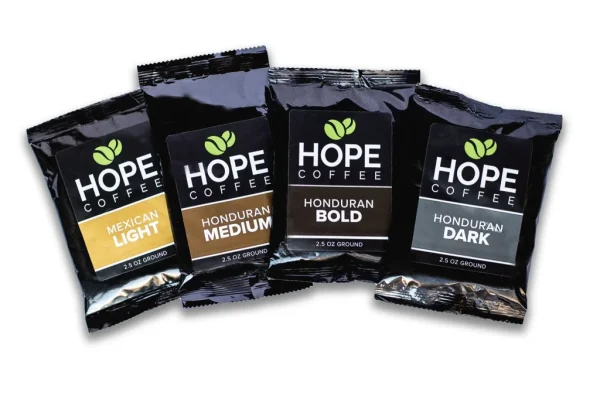
- 2.5 oz bags — for airpot systems running roughly 1.9 to 2.5 liters
- 9 oz bags — for commercial brewers in the 1.5 gallon (1 bag) to 3.0 gallon (2 bags) range
- 5 lb bags — for measuring to whatever your setup requires
This may seem like a small thing, but it can make a pretty big difference in day-to-day operations. We’ve seen this firsthand with churches. One volunteer puts three scoops in the brewer, the next person puts in four, and someone else uses a different scoop altogether. Nobody is trying to make bad coffee. They’re just doing it differently. That’s one reason we developed our 2.5-ounce and 9-ounce packages.
Difference 4: How do I order? Do I get an account?
Retail is usually pretty simple. You buy a bag of coffee and you’re done. Wholesale is different because you’re setting up an ongoing relationship with the roaster. Your pricing, order history, and other account information are kept together, which makes repeat ordering much easier.
The practical benefit is that repeat ordering can take just a few minutes instead of fifteen. Your pricing applies automatically with your login, and someone can look up what you ordered last Christmas when you’re trying to remember what worked for your event.
We have customers who call us because they can’t remember which coffee they ordered six months ago for a particular event. Being able to look at their previous orders saves them from having to start over.
Difference 5: Do I get any customer service service options?
With retail coffee, there’s generally much less opportunity to get help from the person who actually roasted the coffee.
One thing we think is important with wholesale is having a real person you can call. We’ve had customers contact us because their coffee suddenly tastes weak, they’re expecting a larger-than-normal crowd, or they need to get more coffee delivered before an event. Those aren’t unusual situations when you’re serving coffee to a congregation, employees, or customers.
Having someone you can actually call can be really helpful when those situations come up.
Difference 6: Where does the coffee come from? Who grew it?
There’s another difference that’s important to us, although it’s harder to put into a simple comparison chart: where the coffee actually comes from.
It’s often harder for a retail customer to know exactly where the coffee came from or who grew it. A label on a bag of coffee that says “Product of Central America” is very general. By the time the coffee reaches a retail shelf, it can be difficult to know exactly who grew the coffee or how it was purchased.
Buying wholesale doesn’t automatically mean the coffee is more traceable. There are plenty of wholesale roasters that buy coffee through the commodity market. But when you’re dealing directly with a roaster, you have an opportunity to ask more questions about where the coffee came from and how it was purchased.
That’s why we encourage people to ask those questions. Can the roaster tell you where the coffee came from? Can they tell you about the farms or farmers who produced it? Certifications can be useful, but they don’t necessarily tell you the whole story about the relationship between the roaster and the farmer.
A roaster who buys through direct trade relationships can name the farms and farmers. If they can’t provide that information, certifications may be the primary information they can provide about the coffee.
At HOPE Coffee, we know our farmers by name. Our Honduran roasts come from the Siguatepeque region, our Mexican Light from E-Cafe in Chiapas, and our Guatemalan Medium from the Leivas Family. You can read more about them on our Meet The Farmers page of our website.
All of our coffee is 100% Arabica, grown above 1,200 meters (4,000 feet) and specialty grade coffee that meets the cupping standards of 80+ points. We buy directly from small plot family farmers and consistently pay above Fair Trade prices. When possible we also re-invest in the farms and farmers by providing funding to help cover the cost of pickers, fertilizers or other processing costs. We believe this is important because it helps farmers manage some of the financial challenges that come with getting coffee from the farm to market.
This isn’t necessarily a wholesale-versus-retail difference. It’s simply something that’s easier to investigate when you’re buying directly from a roaster and have someone you can talk to.
When retail is the right call
Retail coffee may make more sense if:
- You’re serving small volumes irregularly
- You want maximum variety and rotate constantly
- You have no storage space
- You’re a household, not an organization
When wholesale is the right call
Wholesale tends to make the most sense when you’re buying enough coffee for the pricing, packaging, freshness, and support to make a meaningful difference. Below a certain threshold, the operational advantages don’t outweigh the commitment.
The short version
| Retail | Wholesale | |
|---|---|---|
| Price structure | Flat, includes full supply chain | Tiered by volume, shorter chain |
| Freshness | May spend longer in distribution | Often roasted closer to order |
| Packaging | Home-sized | Equipment-sized |
| Ordering | Transactional | Account-based, repeatable |
| Support | Generally limited | A person you can call |
| Sourcing transparency | Rarely available | Available if you ask |
If your church, business, or organization is buying a significant amount of coffee, these details are worth looking at. They can affect not only what you pay, but also the consistency and quality of the coffee you’re serving. A good brewer certainly matters, but the brewer can only do so much. The coffee itself, how fresh it is, how you measure it, and how it was sourced all play a big part in what ends up in the cup.
If you’d like to compare what you’re spending now against a wholesale quote, our team is happy to walk through it with you. And if you’re a coffee shop rather than an organization, here’s how we work with shops specifically.